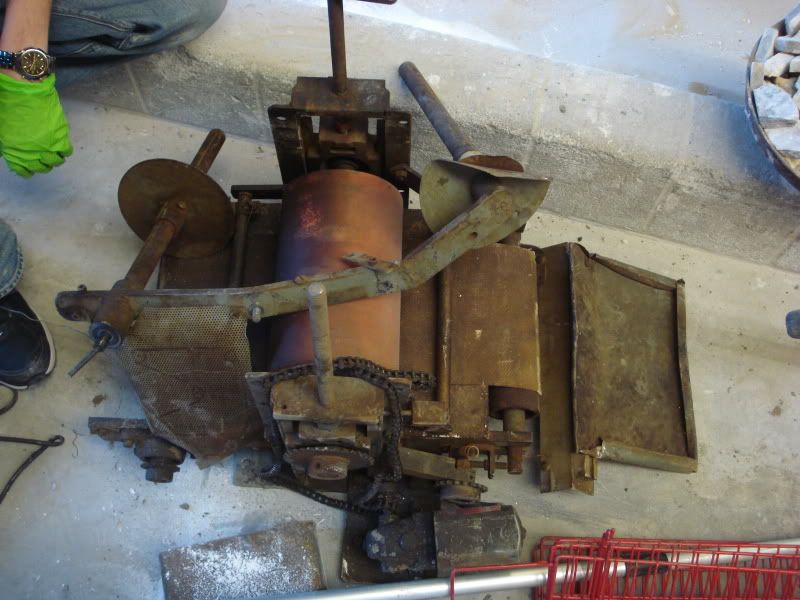
My sculpture class too a field trip to a scrap yard to find metal objects for a welding project. Besides a few pieces of square stock I came across what appears to be some sort of industrial press (possible for flattening small rolls of metal?). My excitement peeked when I realized that the machine was only a few minor modifications away from a small printing press, something I was planning to one day build from scratch. Now I basically had every piece I would need. The bonus: The woman showing us around had “a soft spot for the arts”, and decided to donate all we could scrounge up to the cause. In other words letting us get away with what had to be half a ton of metal for free! What a generous woman.
Taking the machine back to the workshop, me and a friend, Mark Reedy (basically my studio assistant in the project, ha-ha), started to take the thing apart so we could clean off the beautiful light coating of rust and mud that build up over its time in the elements. A wondrous occasion I can only describe as “Man Time”, a bonding experience where guys build stuff.
So far the progress is smooth going, with only a few hitches concerning the workshop’s lack of tools, but it seems we have all the parts we’ll need to make the press, which is quite exciting. The downside, however, is that the project doesn’t particularly pertain to the assignment at hand, so I’ll have to devote the majority of my time and effort to a second project, pushing the progress of this one to one day a week we’ve set aside.
I plan to document the progress of the project on this blog with images and the occasional shaky-cam video, so stay tuned.
Saturday, February 18, 2012


Tuesday, September 20, 2011
"6"
"6"


In a stint of delirium, I went down a hallway outside the room where I was waiting for my class and changed all the locks of the lockers to six. I call the piece “6”. Is this art? I think so, if you’re going to call placing cans of cat food on watermelons art. In your face Gabriel Orozco!


Tuesday, May 10, 2011
Wood and Metal
This semester in college marked the first time I have worked with metal, learning and utilizing multiple techniques of welding, including: MIG, which uses argon to heat up and bond metal; brazing, which includes heating two pieces of metal and melting brass between them, sandwiching the two pieces of metal together; and plasma cutting, which is used to get clean cuts when cutting shapes from a sheet of metal. I was scared while learning the techniques at first, making sure the professor was monitoring me the first few times I put a flaming torch in my hands. Fire, being one beast, is quite different than electricity, being almost unpredictable, and still somewhat mysterious compared to the archaic, primordial fear of fire. I soon put my fears aside and was quick to learn the procedures, however, producing my first piece that involved welding in its creation. I look forward to using my new skills to make more pieces in the future.
Pictured here are my first attempts at brazing, MIG welding and plasma torch cutting.


This is also the first time I have carved wood to create three-dimensional sculptures. Comparing working with metal, a hot, angry, and aggressive process involving fire, gas, blinding light, and sparks, is quite different from the raw, natural, calm and rugged process of working with wood. Given the choice between the two I would pick metal, as it’s a new endeavor for me, but I would prefer the less aggressive nature of wood. I did, however, hurt my self a lot more while carving then I did welding. My hands are a bit manlier now, though. A little finger mutilation builds character.

Here’s my little tribal man, influenced by Chinese mingqi burial figures.

Here’s my zoomorphic rat, also inspired by Asian art.
Saturday, March 5, 2011
Atop "Star-Crossed"

The sculpture “Star-Crossed” by Nancy Holt, is behind the art museum in
Sunday, January 2, 2011
"Happy Cows, Happy Meals" - Plaster Cast Sculpture
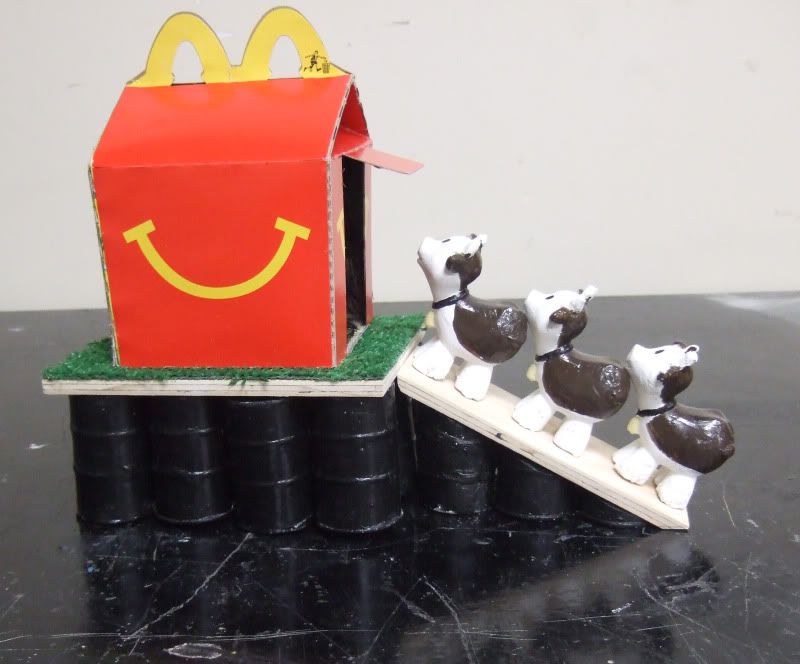
I wanted to do something with barrels, barrels and cars. Something about pollution and how fossil fuel wasn’t a really sustainable fuel source. I had an idea that involved a pyramid made of barrels with a Hummer on top, but the sketch I did wasn’t really interesting, and was too simple. I also had made a mold of a toy cow, so I tried to find a way to relate the two, the cow and the oil barrels. Nothing came to mind, until I was referred to the book, “The Omnivore’s Dilemma” by Michael Pollan, and how in the book it was revealed that it took one barrel, per cow, to raise it, feed it, transport it to slaughter and to restaurant, and to cook it. This I had never heard of, but now I had a topic for my piece.

It’s said that America consumes more beef than any other country in the world, and when people think mass production of beef, they think hamburgers, and when they think hamburgers, they get hungry for Mac Donald’s. Mac Donald’s is one of the largest producers of hamburgers in the world, selling Happy Meals in countries all over the world. Obviously hundreds of thousands of gallons of oil a year is used to transport this beef around the world.
 The oil barrels are the base of the piece, representing all the gallons of oil used to transport the beef to market and restaurants. The plastic grass surrounding the box implies the ground, with the barrels underneath, insinuating the origin of the oil. The three plaster cows are casted from a mold of a plastic child’s toy, making the piece cynical yet innocent, also representing the free toy in every child’s meal, 90% of the reason for buying the meal in the first place, the food, which took thousands of dollars to get there, becoming second. The cows are being led up a ramp into a red, smiling happy meal box, almost like if it were a herd of cattle being led into a slaughter house, and the mouth of a smiling child. Inside the happy meal slaughterhouse is a hung cow carcass, cleaned and prepared for freezing and shipment, ready to be part of a child’s Happy Meal.
(Photo Credit to Roscoe Wilson)
Thursday, December 30, 2010
(Untitled) - Wood Sculpture

I didn’t have a plan going into the wood project. I did some preliminary sketches but they didn’t relate to what I eventually produced. I went with my feelings, and started cutting strips of wood. I tried to make interesting shapes, and ultimately just had fun without any vision in mind. When I had a good pile of strips, I played with the pieces, seeing how they related to each other; what looked nice and interesting. I wanted the piece to look natural and organic, so I decided not to use any screws or adhesives, and just stuck to peg and hole methods of holding the piece together. I sanded several of the pieces in order to reduce kinks, and make it look like each piece flowed into the next without any transitions.

What I ended up with was abstract, and had no real meaning or inspiration. It was a just go-with-my-feelings piece, but I was thinking of the way fish feed when I was constructing it, so maybe there was some subconscious contributions to the way the sculpture turned out. It does resemble some sort of tentacled mass, reminiscent of some abomination born out of Lovecraft’s mind, reaching up from the depths of the sea.
Tuesday, October 5, 2010
Recycling a Plate
Something that I’ve done in the past is resurface old/ abandoned etching plates left by past art students, by scraping off the old image. Usually these plates would remain in a drawer in the art room forever, but once resurfaced I can use the plate again to etch my own image onto it. This reflects my passion for recycling, and my pet peeve of things not being utilized to their full potential.
The process of resurfacing a plat involves me using a scrapper, a triangular-prism shaped tool to scrape down the surface of the plate until it’s even with the image that they’ve etched into it. This process is not only time consuming but demands a lot of physical work, bordering on arduous. The result is a free plate that I would had to have paid for otherwise, and the relief of another plate that would have ended up sitting there in that drawer, forever, until it was eventually thrown away.
The most current plate that I’ve taken to the task of resurfacing is already almost completely blank. Two days of scrapping and the image on the plate is almost completely erased. Making prints of the plate lets me know what area of the plate needs to be worked on further.
Even though scraping only take off a small bit off at a time, I can amass quite a sizable amount of shaving after a few hours.
 Here is a print at the beginning of the day, and a few hours of scrapping after.
In every consecutive print, the image becomes fainter and fainter, until the image is finally gone, and the plate is blank once more, ready for a new image to be etched into it.

Thursday, July 22, 2010
Models
When it comes to anatomical accuracy, I like to use print ads, catalogs or magazines for reference. Here are two models I have used for reference and the pieces I used the references for.

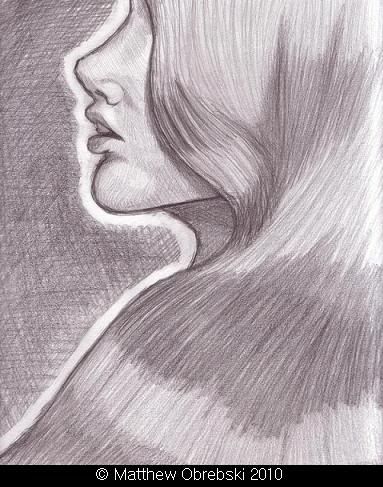
The reference used for “Glimpse”, a graphite drawing that was later made into an intaglio print, was a model from an
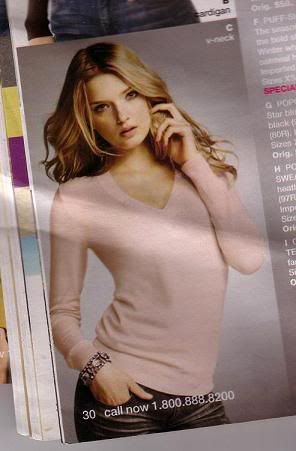

The reference for the piece “Gynoid V.2.0”, a linoleum print, was from the Fall Clearance 2009 catalog of
Friday, May 28, 2010
My first silk screening experience

My mess on the table...
For the last three weeks I’ve been taking a summer class in silk screening my college provided. It was my first
time ever doing silk screening, and it was a lot harder to do than I had initially thought. First off you get wet a lot… or at least we did, since we had to rinse our screens out in such little sinks, and –which I had not anticipated- you have to wash your screen out every few prints to keep the ink from drying in the screen.
So this was my first screen, on to which I exposed multiple images. I chose the Gynoid from previous works, an Automaton Propaganda poster, an image I had tried to make into a wood block at the beginning of the summer, and an image of a woman with VR goggles that I had found in an old PC magazine, with some text I added in PhotoShop. Each of these images were traced with a Sharpie marker, and then photocopied to bring up contrast and strengthen the black. The copies were then dampened with baby oil to make the images transparent, and help adhere them to the screen.
Even though the time I exposed my screen was a bit longer than any of the other students in the class had exposed theirs, about 1 hour and 15 minutes, the emulsion didn’t harden enough, and blow-out occurred in several of the images while removing the softer emulsion. I tried to do as many print of the successful images as I could before they deteriorated too much, and blew the screen out to get ready for the next batch of images.
I plan to revisit most of the imagery in the next batch, as I wasn’t quite satisfied with what I got in the first attempt. I will, however, be shifting over to lithography in the class now, but I will try to find time to revisit silk screening.
Monday, May 24, 2010
"Urban Robo" - woodblock print
Looking back at my early woodblock carvings, I noticed that I would treat the compositions as if they were just line drawings. I would just draw the object of the piece in the middle, and cave everything in and around the lines I drew, instead of utilizing the negative space and carve the object from it.


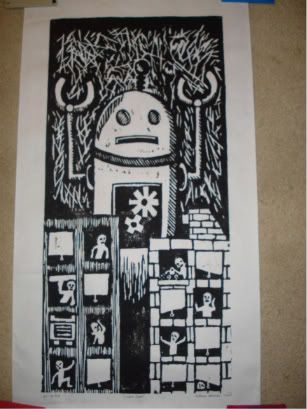

Looking at the woodblocks of other artists, I realized how I should be approaching the carvings, and set out to put as much in a composition as I could, while keeping large masses of black, and not relying on contour lines. I also added hatching and cross hatching to add value to cretin areas.
What resulted was the first piece that I consider to be part of my label CtrlAltRobot. “Urban Robo”, as I would eventually call the piece, was also the piece that started my ongoing theme of technology, and the focus on robots. It was also the piece that I started to develop my own style that I would try to integrate into all of my pieces.
The robot in the piece was supposed to be like one of those old school robots you would always see in those really old science fiction TV shows, like Buck Rodgers (even though I’ve never seen any of that series), and were essentially what the people living the 1930’s would have imagined a robot from the year 2000 would look like. It’s clunky, gear driven, and obsolete. Its memory capacity is really limited; probably no smarter than a calculator, but it’s frick’n huge, so people are panicking when one shows up in the middle of their city, even though it seems to be posing no threat what so ever. People are just afraid of 50 foot robots
The print displays the citizens of the city looking out of the windows of their apartments, all reacting to the robot in different ways. Some are screaming in horror, some are trying to escape, some are oblivious to the robot, and continue their daily lives. What is the meaning of the robot, why is it here, does it pose a threat?
Sunday, May 2, 2010
"Gynoid" - Intaglio
While I was looking through a pile of old magazines for a collage in one of my art classes, I came across an odd and unique image. It was a photo of a woman, passing out pamphlets in the street while wearing a large and bulky sign promoting a newly opened copy center, and a cardboard computer over her head. It was such a weird scene, yet she was able to make it sexy with short shorts and a pair of high heels. The idea of making technology sexy was such a great novelty to me, it was so weird and wacky, and I loved it. I tore the page out and still have it today. A few years later I decided to use my newly acquired skills in the print making form of intaglio to try to reproduce the image in a print.


There exist two series of the print, the first few lack the hatching, and are just the contour drawing. A few prints later minor corrections were made, resulting in the print’s current rendition. I intend to do more with the piece when I have the time.
Sunday, April 25, 2010
"User Friendly" - woodblock print

This woodblock print is titled “User Friendly”. It features three robots playing around with a human. Each robot is from a different point in time and space. The robot on the right is the future robot with an advanced design and telescoping arms. The one in the center is an alien design robot with tentacles and a single optical sensor. Finally, the robot on the left is the retro robot that relies on moving gears for internal mechanics and has outdated optical sensors and limited maneuverability. The retro robot is also the robot that’s featured on my first robot print, “Urban Robo”.
I wanted to make a piece that made the robots look more like children than towering monsters. Sure they’re enormous and emotionless, but they’re also limited in their memory capacity, and were created to help humans in their menial tasks. Basically they’re harmless, but they are large and curious, they think they’re helping us, but they don’t comprehend death or realize if they’re causing harm, making them dangerous.

The design for the print started out as a pencil sketch, and was redrawn on a large sheet of sketchpad paper, and transferred onto the woodblock with tracing paper.
The hatching in the background first seen in the “Urban Robo” print returns to not only continue the design in the first one, making it apparent that they’re part of an ongoing series, but also retain the original purpose of breaking up the large amount of flat black color surrounding the composition.Wednesday, April 21, 2010
In the Future: The iPad
 In the future people will look at the ancient, bulky iPad, and question what they were thinking. It’s a huge thing in our time, it will probably become an icon of this era, and serve as a precursor that will lead the way to all the wondrous devices in the future, but it will become obsolete in the future, to the point that it becomes humorous. People will make sitcoms that take place during 2010, a truly wacky time in their eyes. They will write in a character that has just purchased the iPad, and is completely overwhelmed by its capabilities. The audience will laugh at the enthusiastic character as he reads the specs on the back of the box. “A sixteen gigabyte hard drive, 3G wireless internet”, it’s a dinosaur compared to the devices the people watching the show all have at the time. We, however, will buy one from a garage sale to recount memories of days gone by, a simpler time where you didn’t need a cybernetic implant to read the newspaper, which you’ll be able to read on your toaster, if you could figure out how it works. When we show our grandchildren the iPad, they’re eyes will open wide in amazement. They’ll ask if people really held that thing in their hands when browsing the internet, and we will blow their minds by telling them that people used to sit down when they used computers.
"Downloading" - Intaglio
I got this idea one day to try to do something similar to the Matrix movies, where they plug people into the computer via a port in the back of the persons head, or how they download information and memories form suspects in Ghost in the Shell. Basically I wanted to do a piece featuring a woman having information being downloaded into her mind via cybernetic implant. However, I wanted it to look a little lower tech than the other two so I gave the woman a helmet with a bunch of wires coming out of it. Sort of like the old mind transfer machines that mad scientists would invent in old television shows. In order to push the idea that information was being downloaded into her mind I ran the words down and loading through her eyes, like they were flashing on a screen in her head or something. I also thought it made her look like a cyborg.

The method I used for this piece was intaglio; it’s a form of etching, and one of the older forms of printmaking.

This is the plate that I make the prints with. The process for doing an intaglio piece is pretty interesting, involving acid to etch the lines you draw into the plate, making a recess to hold the ink in.

It’s still a work in progress, as you can see additional line hatching was drawn in later to add more value. I’m still currently working on the piece, removing lines from the composition, which is a whole nother process called scraping and burnishing.
Sunday, April 18, 2010
What is Ctrl+Alt+Robot?
 Control+Alt+Robot is the label under witch my artwork falls under. Pieces that fall under this label all include the theme of human nature merging with computer technology. I intend to use my art to push the line between natural and artificial; humanity and technology, merging the two until they become symbiotic and perverse, while still attaining an eerie sense of familiarity.
We seem to be able to live along with technology. We use it everyday, but we aren’t dependant on it, are we? At what point do we lose control of what we’ve created, and it starts to control us? What if we integrated technology into our lives to the point that we needed it to survive, or even function normally? What if we came to the point where we would question who was human any more, or what it even meant to be human? Where’s the line that says we’ve crossed from human into something beyond, or better?
I intend to use this blog to showcase my latest works, older works, random doodles and comics. This blog will give me the opportunity to discus and explain my works, inspirations, muses and ideals. The images I will display on this blog belong to me, and should be considered copyrighted, unless stated otherwise.
Subscribe to:
Posts (Atom)
About Me

- Matt O.
- I am the creator of Lego stop-motion animation Shadow of the Brick, go watch it on my Youtube channel Green Dragon Films. I also play old games on the YouTube channel Matt's Gameplay. I also make art involving robots and other weird science themes. Fallow me on Twitter: @ControlAltRobot