Gallery

Sunday, January 2, 2011

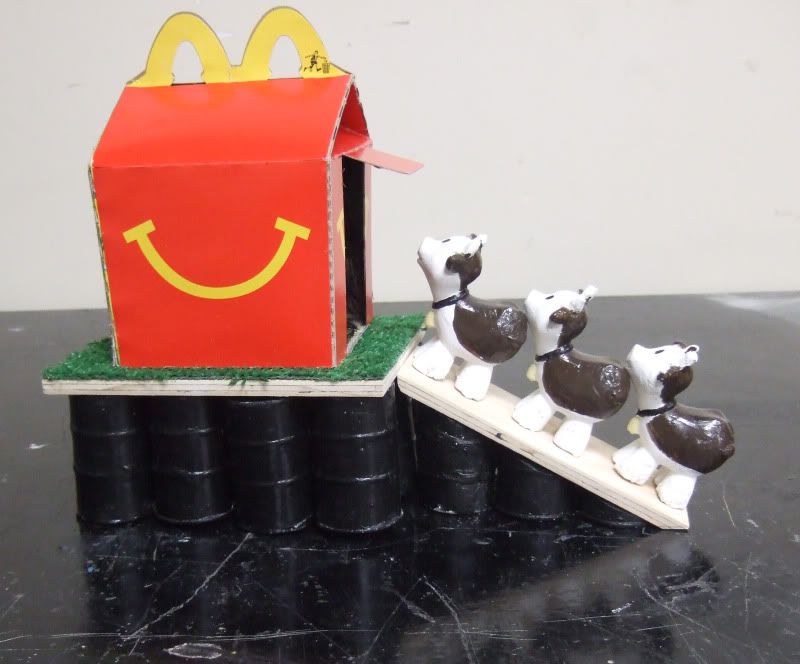
"Happy Cows, Happy Meals" - Plaster Cast Sculpture


I wanted to do something with barrels, barrels and cars. Something about pollution and how fossil fuel wasn’t a really sustainable fuel source. I had an idea that involved a pyramid made of barrels with a Hummer on top, but the sketch I did wasn’t really interesting, and was too simple. I also had made a mold of a toy cow, so I tried to find a way to relate the two, the cow and the oil barrels. Nothing came to mind, until I was referred to the book, “The Omnivore’s Dilemma” by Michael Pollan, and how in the book it was revealed that it took one barrel, per cow, to raise it, feed it, transport it to slaughter and to restaurant, and to cook it. This I had never heard of, but now I had a topic for my piece.


It’s said that America consumes more beef than any other country in the world, and when people think mass production of beef, they think hamburgers, and when they think hamburgers, they get hungry for Mac Donald’s. Mac Donald’s is one of the largest producers of hamburgers in the world, selling Happy Meals in countries all over the world. Obviously hundreds of thousands of gallons of oil a year is used to transport this beef around the world.


The oil barrels are the base of the piece, representing all the gallons of oil used to transport the beef to market and restaurants. The plastic grass surrounding the box implies the ground, with the barrels underneath, insinuating the origin of the oil. The three plaster cows are casted from a mold of a plastic child’s toy, making the piece cynical yet innocent, also representing the free toy in every child’s meal, 90% of the reason for buying the meal in the first place, the food, which took thousands of dollars to get there, becoming second. The cows are being led up a ramp into a red, smiling happy meal box, almost like if it were a herd of cattle being led into a slaughter house, and the mouth of a smiling child. Inside the happy meal slaughterhouse is a hung cow carcass, cleaned and prepared for freezing and shipment, ready to be part of a child’s Happy Meal.


(Photo Credit to Roscoe Wilson)

Thursday, December 30, 2010

(Untitled) - Wood Sculpture


I didn’t have a plan going into the wood project. I did some preliminary sketches but they didn’t relate to what I eventually produced. I went with my feelings, and started cutting strips of wood. I tried to make interesting shapes, and ultimately just had fun without any vision in mind. When I had a good pile of strips, I played with the pieces, seeing how they related to each other; what looked nice and interesting. I wanted the piece to look natural and organic, so I decided not to use any screws or adhesives, and just stuck to peg and hole methods of holding the piece together. I sanded several of the pieces in order to reduce kinks, and make it look like each piece flowed into the next without any transitions.

What I ended up with was abstract, and had no real meaning or inspiration. It was a just go-with-my-feelings piece, but I was thinking of the way fish feed when I was constructing it, so maybe there was some subconscious contributions to the way the sculpture turned out. It does resemble some sort of tentacled mass, reminiscent of some abomination born out of Lovecraft’s mind, reaching up from the depths of the sea.

Tuesday, October 5, 2010

Recycling a Plate

Something that I’ve done in the past is resurface old/ abandoned etching plates left by past art students, by scraping off the old image. Usually these plates would remain in a drawer in the art room forever, but once resurfaced I can use the plate again to etch my own image onto it. This reflects my passion for recycling, and my pet peeve of things not being utilized to their full potential.


The process of resurfacing a plat involves me using a scrapper, a triangular-prism shaped tool to scrape down the surface of the plate until it’s even with the image that they’ve etched into it. This process is not only time consuming but demands a lot of physical work, bordering on arduous. The result is a free plate that I would had to have paid for otherwise, and the relief of another plate that would have ended up sitting there in that drawer, forever, until it was eventually thrown away.

The most current plate that I’ve taken to the task of resurfacing is already almost completely blank. Two days of scrapping and the image on the plate is almost completely erased. Making prints of the plate lets me know what area of the plate needs to be worked on further.
Photobucket

Even though scraping only take off a small bit off at a time, I can amass quite a sizable amount of shaving after a few hours.

Here is a print at the beginning of the day, and a few hours of scrapping after.

In every consecutive print, the image becomes fainter and fainter, until the image is finally gone, and the plate is blank once more, ready for a new image to be etched into it.
Photobucket

Thursday, July 22, 2010

Models

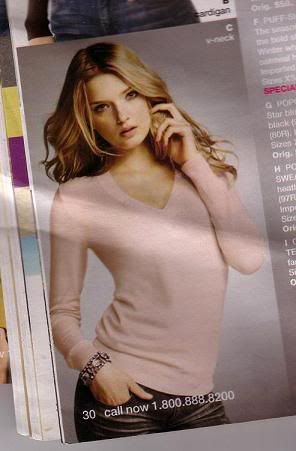
When it comes to anatomical accuracy, I like to use print ads, catalogs or magazines for reference. Here are two models I have used for reference and the pieces I used the references for.

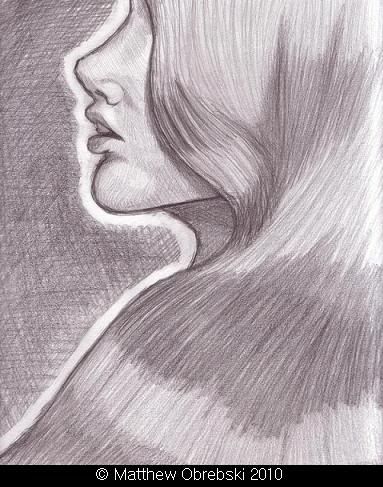
The reference used for “Glimpse”, a graphite drawing that was later made into an intaglio print, was a model from an Avon catalog, Campaign 18, 2009, on page 150 to be precise.


The reference for the piece “Gynoid V.2.0”, a linoleum print, was from the Fall Clearance 2009 catalog of Victoria’s Secret, page 30. You might notice, I forgot to flip the image when transferring it onto the linoleum block, so the image prints backwards, but who cares.

Friday, May 28, 2010

My first silk screening experience


My mess on the table...

For the last three weeks I’ve been taking a summer class in silk screening my college provided. It was my first

time ever doing silk screening, and it was a lot harder to do than I had initially thought. First off you get wet a lot… or at least we did, since we had to rinse our screens out in such little sinks, and –which I had not anticipated- you have to wash your screen out every few prints to keep the ink from drying in the screen.

So this was my first screen, on to which I exposed multiple images. I chose the Gynoid from previous works, an Automaton Propaganda poster, an image I had tried to make into a wood block at the beginning of the summer, and an image of a woman with VR goggles that I had found in an old PC magazine, with some text I added in PhotoShop. Each of these images were traced with a Sharpie marker, and then photocopied to bring up contrast and strengthen the black. The copies were then dampened with baby oil to make the images transparent, and help adhere them to the screen.

Even though the time I exposed my screen was a bit longer than any of the other students in the class had exposed theirs, about 1 hour and 15 minutes, the emulsion didn’t harden enough, and blow-out occurred in several of the images while removing the softer emulsion. I tried to do as many print of the successful images as I could before they deteriorated too much, and blew the screen out to get ready for the next batch of images.

I plan to revisit most of the imagery in the next batch, as I wasn’t quite satisfied with what I got in the first attempt. I will, however, be shifting over to lithography in the class now, but I will try to find time to revisit silk screening.

Monday, May 24, 2010

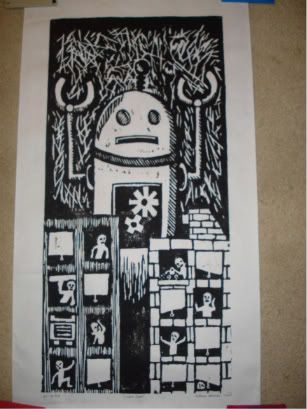
"Urban Robo" - woodblock print

Looking back at my early woodblock carvings, I noticed that I would treat the compositions as if they were just line drawings. I would just draw the object of the piece in the middle, and cave everything in and around the lines I drew, instead of utilizing the negative space and carve the object from it.


Looking at the woodblocks of other artists, I realized how I should be approaching the carvings, and set out to put as much in a composition as I could, while keeping large masses of black, and not relying on contour lines. I also added hatching and cross hatching to add value to cretin areas.

What resulted was the first piece that I consider to be part of my label CtrlAltRobot. “Urban Robo”, as I would eventually call the piece, was also the piece that started my ongoing theme of technology, and the focus on robots. It was also the piece that I started to develop my own style that I would try to integrate into all of my pieces.

The robot in the piece was supposed to be like one of those old school robots you would always see in those really old science fiction TV shows, like Buck Rodgers (even though I’ve never seen any of that series), and were essentially what the people living the 1930’s would have imagined a robot from the year 2000 would look like. It’s clunky, gear driven, and obsolete. Its memory capacity is really limited; probably no smarter than a calculator, but it’s frick’n huge, so people are panicking when one shows up in the middle of their city, even though it seems to be posing no threat what so ever. People are just afraid of 50 foot robots

The print displays the citizens of the city looking out of the windows of their apartments, all reacting to the robot in different ways. Some are screaming in horror, some are trying to escape, some are oblivious to the robot, and continue their daily lives. What is the meaning of the robot, why is it here, does it pose a threat?

Sunday, May 2, 2010

"Gynoid" - Intaglio

While I was looking through a pile of old magazines for a collage in one of my art classes, I came across an odd and unique image. It was a photo of a woman, passing out pamphlets in the street while wearing a large and bulky sign promoting a newly opened copy center, and a cardboard computer over her head. It was such a weird scene, yet she was able to make it sexy with short shorts and a pair of high heels. The idea of making technology sexy was such a great novelty to me, it was so weird and wacky, and I loved it. I tore the page out and still have it today. A few years later I decided to use my newly acquired skills in the print making form of intaglio to try to reproduce the image in a print.


There exist two series of the print, the first few lack the hatching, and are just the contour drawing. A few prints later minor corrections were made, resulting in the print’s current rendition. I intend to do more with the piece when I have the time.

About Me

My photo
I am the creator of Lego stop-motion animation Shadow of the Brick, go watch it on my Youtube channel Green Dragon Films. I also play old games on the YouTube channel Matt's Gameplay. I also make art involving robots and other weird science themes. Fallow me on Twitter: @ControlAltRobot

Blog Archive